
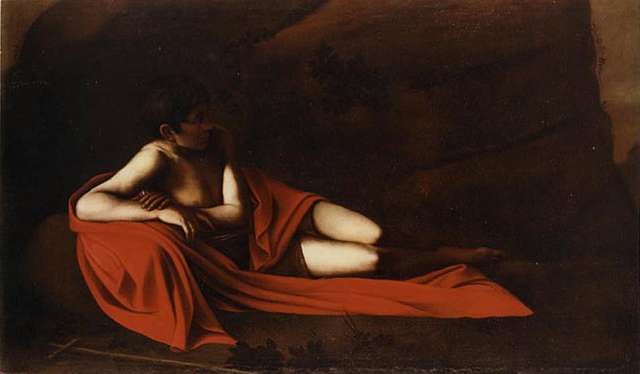
Caravaggio, Saint John the Baptist Reclining, 1610. Private Collection.
Some muses are fleeting, others hang around. For me, Caravaggio falls into the latter category, persistently hovering in the shadows of my mind. I guess one should expect as much from a painter famous as a master of light and the chiaroscuro method.
I’ve been drawn to his work for as long as I can remember. When the characters and setting for my debut novel, Finding Vincent, began to crystallise around an art contest like no other, Caravaggio soon made his presence felt.
An artist of phenomenal talent and temper, he remains an inspiration centuries after his death in 1610. Many seventeenth century Dutch painters travelling to Italy were influenced by the Caravaggist school of painting and later became known as the Utrecht Caravaggists.
Utrecht was one of the seven provinces forming the Dutch Republic (1588 – 1795) and also a major city in the region.
One Dutch painter who visited Italy in 1604 was Hendrick ter Brugghen. When he returned home to Utrecht around ten years later, his style was transformed by his time in Rome and Naples.
Of all the Utrecht Caravaggists, Ter Brugghen is the only one who may have actually met Caravaggio, who fled Rome in 1606 after murdering a man, only to die in 1610 before he could return.
Many artists feature within the pages of Finding Vincent, but it is the work of Hendrick ter Brugghen, and one of his paintings in particular, that to story centres around. More on that next time when I will start a tour of the paintings I have curated from around the world to create a fictional art collection to die for..
Many books have helped me create Finding Vincent, first amongst a long bibliography is the stunning Sinners and Saints, by Dennis P. Weller, an inspiring and visually beautiful book for all lovers of Caravaggio and his followers.
 Kerry Cooper