
Number one: The Bagpipe Player, Heinrich ter Brugghen
Many paintings feature within the pages of Finding Vincent, my debut novel. Curating a world class art collection on behalf of my protagonist, Max Forsyth, has allowed me to “acquire” art from a broad range of genres. Each piece has a story of its own to tell.
Key to the narrative arc of the novel is The Piper, painted by Ter Brugghen, circa 1624.
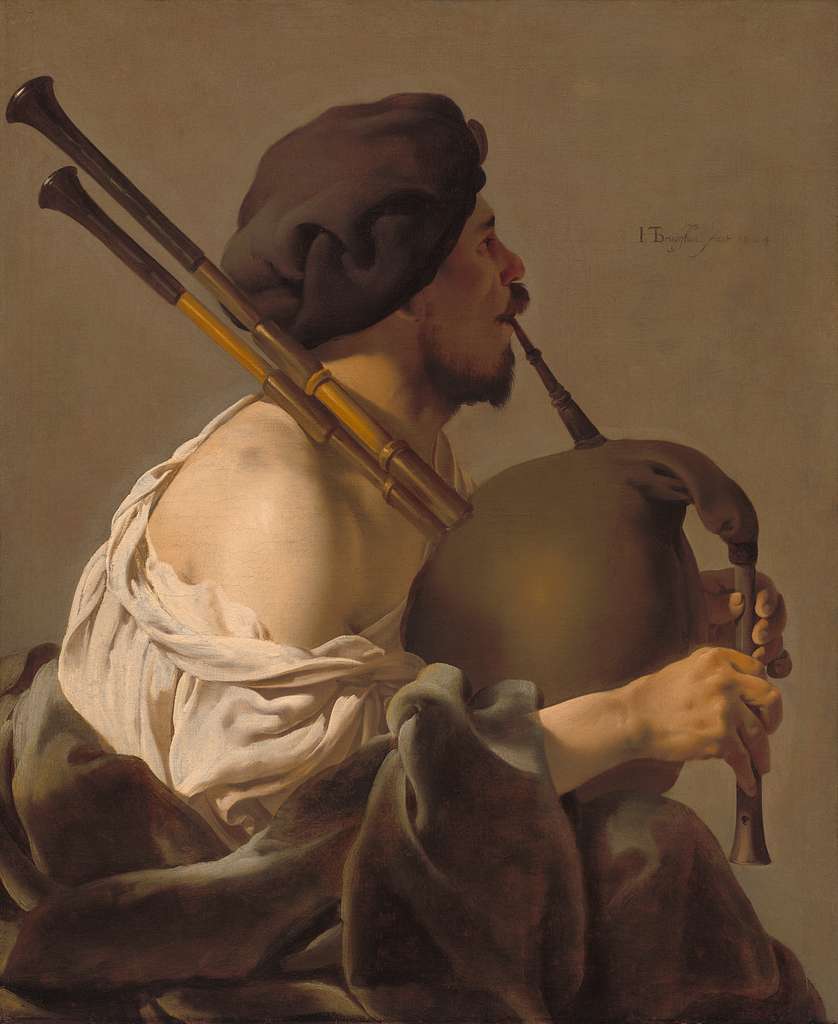
In Max’s world, this painting resides in the “Lady’s corridor” of his Highland castle. In reality, it is part of a collection housed in The Museum of Fine Arts, in Houston, Texas. It was acquired by the Sarah Campbell Balffer Foundation in 1978.
I stumbled across this painting whilst researching the work of my muse, Caravaggio. Three elements of this painting grabbed my attention. First and foremost is the light. It is hard to avoid the influence of Caravaggio on the work of Ter Brugghen and this painting illustrates this so well. As the light falls on the musicians shoulder it brings form and tone to the muted colours of his shirt and cloak but leaves his face, enigmatically, in shadow. Already the painting is building intrigue.
In my previous posting, Musings, I discuss the possiblity that Ter Brugghen was the only Utrecht Caravaggist (follower of Caravaggio living in Utrecht, Holland) to actually meet Caravaggio in Italy. Certainly Ter Brugghen’s time in Italy overlapped with Caravaggio’s. Oddly, no record of Ter Brugghen’s ten years in Italy survives, nor does any artwork from that period, so we may never know if the two masters did actually meet. What is certain, however, is the incredible influence Caravaggio had on Ter Brugghen’s later work – and his treatment of light is core to this.
The second element that draws me into this painting is the bagpipes. As a Scot, currently living just south of the border, bagpipes never fail to ignite a rush of homesickness. Even a few notes from this most mysterious of instruments can move me to tears.
There are many interpretations of Ter Brugghen’s use of instruments, singers and music in his work. Some scholars think they may be metaphors for the brief pleasures of life, others see them as representations of the country idyll. Certainly there was a strong interest in the pastoral in the early 17th century and the bagpipes and violins portrayed by Ter Brugghen were viewed at that time as folk instruments.
Perhaps Ter Brugghen simply loved to paint musicians. Over one third of his surviving work shows either singers or musicians, many paintings are in the single figure genre which was common for followers of Caravaggio. Ter Brugghen painted a series of musical portraits, featuring bagpipes, lutes, violins and singers.
In his unsettling work, David praised by the Israelite Women, 1623, Ter Brugghen actually signed and dated this work on the sheet of music held by one of the women greeting the pensive David. Surely this illustrates how powerfully embedded music was within Ter Brugghen’s art?
Or was his ‘intent’ was simply to represent the joy that music brings?
The final element that stands out for me is the composition of The Bagpipe Player. Before I begin a portrait, no matter whether it is of a human or animal, one of the first decisions I will make is on eye contact. Where the subject of a portrait gazes is key to the impact of the finished painting. Who hasn’t encountered the eyes that follow you around the room?
The genius of this portrait, for me, is how much emotion the piper radiates despite his head being turned away from us. Are we drawn in because he is lost in his music? Because he doesn’t make eye contact? Or is it back to the subtle play of light and shadow that Ter Brugghen wields so well?
The artist is undoubtedly a master of composition on many levels. The strong diagonal created by the pipes of the instrument draw us down to the highlighted shoulder then on to the delicately rendered and beautifully lit hand. Our eyes are then led up the chanter to the expressive mouth and shadowed face of the piper. Ter Brugghen masterfully moves us around the canvas and then back down to the sumptuous folds of fabric in the clothing.
When researching the life of Ter Brugghen I was surprised by the fact that no record of his time in Italy exists and even more intriguing, not a single sketch or painting has survived from his ten years in Rome and Naples. I find it unimaginable that he did not create work in the decade he spent away from his homeland, surrounded by the beauty of Italy, and the genius of Caravaggio. What happened to all his work? This is fertile ground for a novelist…
Then there is the troublesome fact around Ter Brugghen’s oeuvre – the number of replica’s that exist of his work. He created multiple versions of paintings – known as ‘autograph replicas’ – some are even signed in the same year. With excellent provenance, signed and dated by the artist, each version is slightly different and show signs that they have been developed from the initial ‘prime’ originalwork. For example, later versions often lack what are know as ‘pentimenti’ small adjustments in composition or colour choice that show the artist’s creative process at work. Copies lack pentimenti as the thinking work has already (mostly) been done.
This exceptional, intriguing, painting introduced me to an artist who is now considered amongst the most influential and important of the Utrecht Caravaggists.
Max Forsyth’s search for the perfect painting has led to the purchase of many masterpieces. But is his painting the original, prime version of The Bagpipe player? Could he be in possession of an autograph replica, a later work by Ter Brugghen based on the original? Is his painting from the workshop of the artist, a copy created by one of his students for the purposes of learning? Or – could the work be a fake?
Join Max in Finding Vincent to uncover the truth…
 Kerry Cooper