
View of the Sea at Scheveningen, Vincent Van Gogh, August 1882
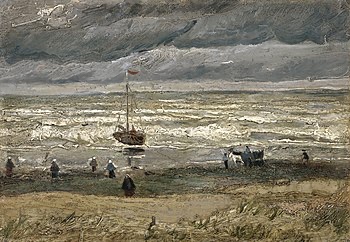
‘The wind blew so hard that I could scarcely stay on my feet and could hardly see for the sand that was flying around,’ wrote Vincent Van Gogh to his brother, Theo.
The result of his battle on windswept dunes, fighting an August storm, was View of the Sea at Scheveningen. Vincent’s account of the day spent painting outdoors is evidenced by the grains of sand embedded in the oil paint, still visible today.
When I first read about the incredible provenance of this painting – its history and ownership – I felt that few artworks could surpass it in terms of the richness of its backstory. It got me thinking what it would be like to own such a painting, how its journey would add so much intangible value to the painting that it would surely be the crowning glory of any collection. But what if it wasn’t? How could a collector possibly find the seascape lacking? What would that say about the collector? Why would they feel that way? From these thoughts my protagonist – Max Forsyth – was formed.
The original seascape is currently on display in the Van Gogh Museum in Amsterdam. In my debut novel, Finding Vincent, I have created an opportunity for Max to purchase this incredible work – a masterpiece with the ultimate provenance. When Max discovers the painting doesn’t meet his needs his shock is immense. His reaction to the seascape demands that he faces his past, his relationship with art and those closest to him.
Scheveningen, a stunning dune beach close to the Hague, is as popular today as it was in Van Gogh’s time when it was considered highly fashionable.
Vincent visited the beach many times before he painted this seascape, one of only two he painted in Holland. He visited Scheveningen with his brother, Theo, just after he left school in 1872 and began his first job, working for art dealers Goupil and Cie. He returned in 1877, spending time with his cousin-in-law, the renowned realist painter, Anton Mauve, who had a studio in the Hague. When Vincent left he was determined to return and paint.
The day Van Gogh did paint the beach at Scheveningen most of us would have stayed indoors nursing a coffee. Instead, Vincent made the arduous journey to the beach on foot, laden with newly purchased supplies funded by his brother. He was weighed down with his heavy easel and carried coffee and bread to sustain him on his mission.
Key to his trip was the purchase of oil paint in tubes. The advent of the paint tube is widely considered to have enabled the impressionist movement – allowing artists to take paint outdoors easily.
Van Gogh was been reluctant to paint in oils and try landscape painting. Theo had been encouraging him to do so for some time, as he knew from his work as an art dealer with Goupil and Cie that landscapes in oil were more commercially viable than the figurative work Van Gogh was creating.
Finally Vincent relented and produced View of the Sea at Scheveningen despite all mother nature threw at him. Viewing the work today, one gets the sense that the weather helped inspire Vincent to work, rather than deter his enthusiasm. His liberal use of expensive oil paint captures the frenetic energy of the wind and sea, a reflection perhaps of his own, flying thoughts and passions.
As the painting stands it is an incredible work. But what elevates it further is its rich provenance. In 2002 the seascape was stolen from the Van Gogh Museum along with Congregation leaving the Reformed Church. Fourteen years later the painting was recovered, badly damaged, from the basement of a gang member’s home in the outskirts of Naples.
The work required extensive conservation. The painting was created on paper attached to canvas. During the theft it was torn from its frame and the bottom left hand corner ripped off. Vincent had used so much paint in this area that in order to repair the painting a 3D model was created and used to replace the missing area before being overpainted.
After its eventful journey to Italy the work was put back on display in 2019.
This early work, with its expressive brushwork and understanding of colour and tone, foreshadows Vincent’s later more famous landscape paintings. It was some time before he returned to using oils, little over a month after creating the seascape he stopped painting entirely and returned to studies of the figure in pencil and charcoal.
Capturing the elemental nature of a summer storm is a challenge for the most accomplished painter. Producing View of the Sea at Scheveningen so early in his career shows Vincent’s understanding of colour and tone and his emerging genius – his ability to use brushwork to capture movement, energy and emotion.
 Kerry Cooper